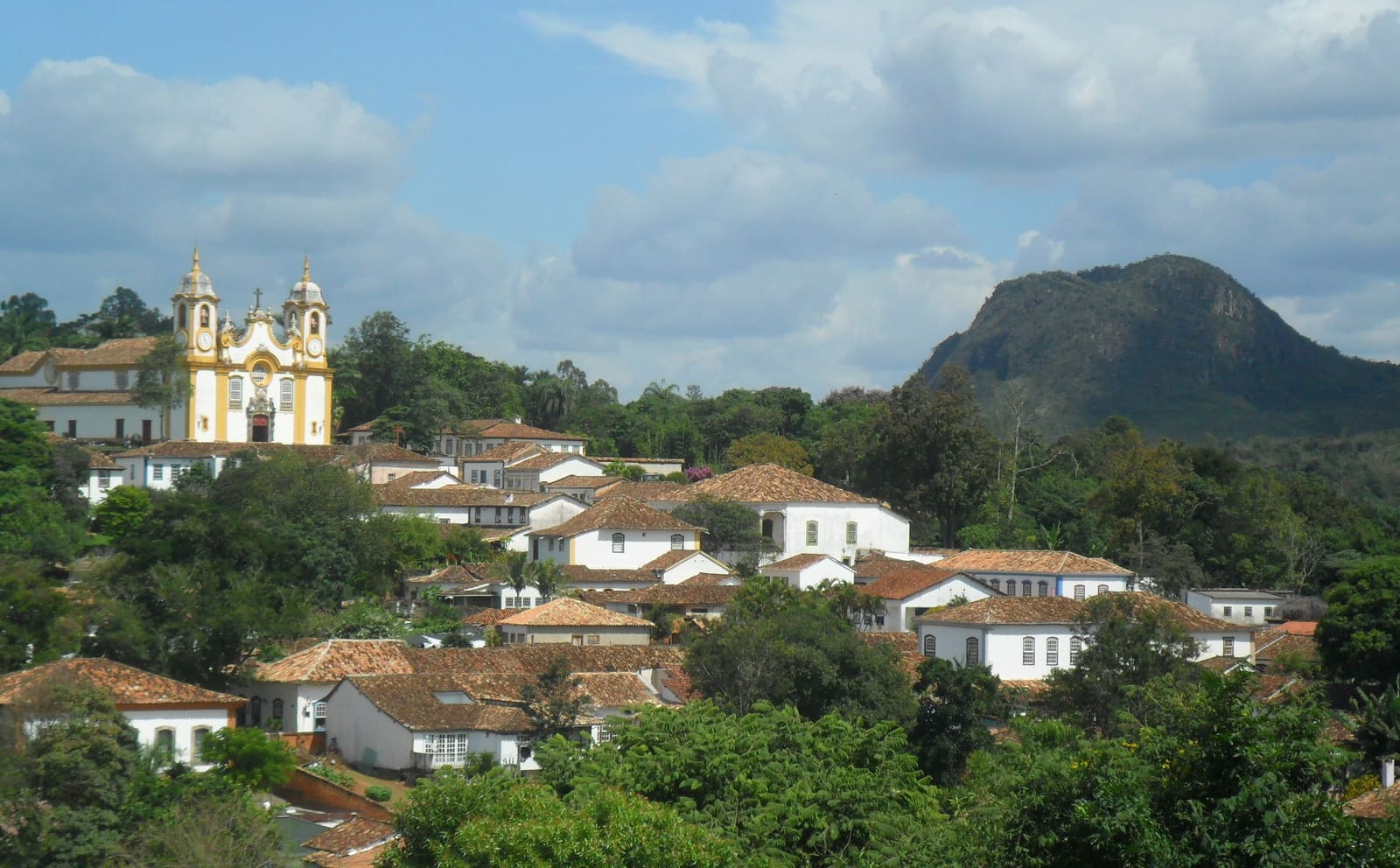
Tiradentes is worth 2 to 3 days: for the churches and the historic center, unhurried meals, a steam train ride to São João del-Rei and a hike in the mountains. The driest months run from May to September, with highs of 24 to 26 °C and lows down to 10 °C in June and July; summer, from December to March, is rainier (327 mm in December).
What to expect in Tiradentes
Tiradentes was born in the gold mining boom of the early 18th century and stopped in time when the gold ran out, to the great luck of today's visitors. The name honors the martyr of the Inconfidência Mineira (the colonial independence conspiracy), but the town is an almost intact Baroque ensemble: cobblestone streets, colorful colonial houses and the Matriz de Santo Antônio (the mother church), one of the richest churches in Minas, with a facade attributed to Aleijadinho and altars covered in gold. All of it in a town of just over seven thousand people, tucked against the Serra de São José.
At almost a thousand meters above sea level, Tiradentes has the mild climate of the Minas mountains: a warm, rainy summer from December to March, with heavy afternoon downpours, and a dry, cool winter from June to August, with sunny days and nights that call for a jacket. A low of around 10 °C is not unusual. The dry season, from May to September, is the most comfortable for walking the slopes and hiking in the mountains; summer leaves everything green, but the stones get slippery.
Tiradentes is explored on foot and at an easy pace. The Matriz, the Largo das Forras, the colonial fountain and the brotherhood churches fit into a morning; afternoons belong to furniture and silversmith workshops, antique shops and one of the best food scenes in inland Brazil: it is no accident that the town hosts one of the country's largest food festivals, in August. To extend your trip, the steam train (the Maria Fumaça, from 1880) goes to neighboring São João del-Rei, and the Serra de São José offers trails and waterfalls. It is a destination for couples, for eating well and taking your time.
Updated on October 19, 2026
Must-sees in Tiradentes
Matriz de Santo Antônio Church
An 18th-century Baroque church with a facade attributed to Aleijadinho and altars covered with hundreds of kilos of gold.
Tiradentes to São João del-Rei steam train
A steam locomotive that covers 12 km of track alongside the Rio das Mortes and the Serra de São José.
Largo das Forras
The town's central square and meeting point, surrounded by trees, horse-drawn carriages, pousadas (small inns) and restaurants.
Chafariz de São José
A public fountain from 1749 that supplied the town with water piped down from the Serra de São José.
Serra de São José
An environmental protection area with trails, viewpoints and Atlantic Forest that frames the historic town.
Padre Toledo Museum
An 18th-century colonial house that belonged to one of the conspirators of the Inconfidência, now a museum with sacred art and period furniture.
Church of Nossa Senhora do Rosário dos Pretos
An early 18th-century church built by the brotherhood of enslaved people, with carvings and paintings from the colonial period.
Workshops and antique shops in the center
Cobblestone streets with workshops selling rustic furniture, silverware, pewter pieces and contemporary art from Minas.
Best time to visit Tiradentes
Brazil is in the Southern Hemisphere, so the seasons are the reverse of those in Europe and North America: summer falls between December and March and winter between June and August. Because of the altitude (927 m), winter is cool: in June and July, the coldest months, the average high is 24 °C and the low is 10 °C. The hottest month is February, with an average high of 29 °C. The reference climate is that of the São João del-Rei station, about 12 km away.
Rain is concentrated in summer. December is the rainiest month, with 327 mm over 18 days, followed by January (320 mm over 17 days) and November (196 mm over 13 days). The driest months are July, with 12 mm over 2 days, June, with 15 mm over 2 days, and August, with 22 mm over 3 days.
The best window for walking and hiking runs from May to September, with July the driest month: sunny days, cool nights and far less rain. In summer the landscape looks greener, but the street stones are slippery in the rain, and you cannot be sure of the weather in advance.
| Month | High | Low | Rain | Rainy days | Rating |
|---|---|---|---|---|---|
| January | 28 °C | 17 °C | 320 mm | 17 | Fair |
| February | 29 °C | 17 °C | 184 mm | 12 | Fair |
| March | 28 °C | 17 °C | 193 mm | 11 | Fair |
| April | 27 °C | 15 °C | 65 mm | 6 | Good |
| May | 25 °C | 12 °C | 41 mm | 4 | Very good |
| June | 24 °C | 10 °C | 15 mm | 2 | Very good |
| July | 24 °C | 10 °C | 12 mm | 2 | Very good |
| August | 25 °C | 11 °C | 22 mm | 3 | Very good |
| September | 26 °C | 13 °C | 78 mm | 6 | Very good |
| October | 27 °C | 15 °C | 129 mm | 9 | Good |
| November | 27 °C | 16 °C | 196 mm | 13 | Fair |
| December | 27 °C | 17 °C | 327 mm | 18 | Fair |
Monthly averages for 1991-2020 from INMET (Brazil's National Institute of Meteorology). The rating combines rainfall, temperature and humidity.
The weather in Tiradentes, season by season
In summer (December to February), Tiradentes has highs of around 28 °C (82 °F) and lows of 17 °C (63 °F), and it is the wetter season, with about 277 mm of rain spread over about 16 days a month. The days are hot and call for beach time and shade.
In fall (March to May), Tiradentes has highs of around 27 °C (81 °F) and lows of 15 °C (59 °F), and it is the wetter season, with about 100 mm of rain spread over about 7 days a month. Temperatures are pleasant for sightseeing all day.
In winter (June to August), Tiradentes has highs of around 24 °C (75 °F) and lows of 10 °C (50 °F), and it is the driest time of year, with about 16 mm of rain a month. The weather is milder, good for walking and exploring without the summer heat.
In spring (September to November), Tiradentes has highs of around 27 °C (81 °F) and lows of 15 °C (59 °F), and it is the wetter season, with about 134 mm of rain spread over about 9 days a month. Temperatures are pleasant for sightseeing all day.
Tiradentes in every month of the year
Weather, crowds, prices and what is happening at the destination in each period. Tap a month to open its full page; the colored dot shows how good the time is for a visit.
Recurring events in Tiradentes
Tiradentes Film Showcase (Mostra de Cinema de Tiradentes)
A national film festival with free screenings, discussions and workshops in the town squares, in late January.
Tiradentes Bike Fest
A large motorcycle gathering with concerts and rides, around the June 24 holiday.
Tiradentes Culture and Gastronomy Festival (Festival de Cultura e Gastronomia de Tiradentes)
One of the country's biggest food festivals, with renowned chefs and Minas Gerais cooking, in August.
Recurring annual events: exact dates change every year, so confirm them before you plan your trip.
Getting to Tiradentes from abroad
The nearest main airport is Tancredo Neves International Airport in Confins (CNF), near Belo Horizonte, about 231 km from Tiradentes. São João del-Rei, about 12 km away, has a bus station.
The rest of the trip is by road. From Belo Horizonte, Tiradentes is 190 km away (about 3 hours) via the BR-040 and BR-265; from Rio de Janeiro it is 325 km (about 5 hours); from São Paulo, 480 km (about 6 hours); and from Ouro Preto, 155 km (about 2 h 50 min).
Routes and airlines change often, so it is safest to check them when you plan your trip.
Hotels in Tiradentes
Tiradentes is small and best explored on foot, so it pays to stay near the historic center, where the Matriz, the Largo das Forras and the restaurants are. The streets are uneven cobblestones and there are slopes, something to keep in mind when choosing your lodging and footwear. You can also sleep in São João del-Rei, 12 km away, and visit Tiradentes as a day trip, since the steam train and the road link the two towns.
Rates change with the dates: confirm the price on Booking.com.
Practical information for visitors from abroad
Frequently asked questions about Tiradentes
What is the best time to travel to Tiradentes?
The dry season, from May to September, is the most comfortable: sunny days, cool nights and mountain trails without mud. In August the famous food festival takes place. Summer (December to March) is rainy and hotter, with green scenery but slippery stones.
How many days do you need in Tiradentes?
Two to three days is enough to see the churches and the historic center, eat without rushing, ride the steam train to São João del-Rei and still hike in the Serra de São José.
Tiradentes or Ouro Preto?
Both are gems of Minas Baroque. Tiradentes is smaller, more charming and quieter, with a strong food and workshop scene, ideal for couples. Ouro Preto is bigger, steeper and has more churches and museums. You can combine the two on a trip through Minas.
Do you need a car in Tiradentes?
Not in the historic center, where everything is done on foot. A car helps for getting there, for the Serra de São José and for combining with São João del-Rei, although the steam train also covers that route.
How does the Tiradentes steam train work?
It is a steam locomotive that covers about 12 km between Tiradentes and São João del-Rei, running alongside the Rio das Mortes and the Serra de São José. It usually runs Thursday to Sunday and on public holidays; confirm the schedule before you go.
Is Tiradentes good for food lovers?
Yes, very much. The town has an unusual density of good restaurants for its size and hosts the Festival de Cultura e Gastronomia (culture and food festival) in August, one of the largest in the country. Contemporary Minas cooking is the specialty.
Other destinations in Brazil
The weather and population data in this guide come from official agencies and open databases. Entry requirements and health recommendations change: always check the official source linked.