
10· 1 review
Niterói Tour
Embark on a fascinating tour of Niterói, where you'll discover the town's most impressive attractions, steeped in history and captivating architecture.
5 h
from US$ 89
Niterói deserves 1 to 2 days: one for the MAC and the Niemeyer Way, and another for the ocean beaches of Itacoatiara, Camboinhas or Piratininga. The best window runs from May to September, with highs of 25 to 27 °C and 41 to 70 mm of rain a month; summer is hotter (up to 30 °C in January) and rainier, with 137 mm over 13 days in both December and January.
People who live in Rio often say that the best view of their city is not in Rio but in Niterói, across Guanabara Bay. From there, from the top of Parque da Cidade or from the suspended balcony of the MAC (Niterói Contemporary Art Museum), Sugarloaf Mountain, Christ the Redeemer and the bay itself appear in full, with no buildings in the way. Oscar Niemeyer's museum, perched on a cliff in Boa Viagem like a concrete disc, became the symbol of the city before turning thirty and remains the most cited reason to cross the bay.
But Niterói does not live on lookouts alone. The city has a strip of ocean beaches that Rio does not: Itacoatiara, surrounded by preserved Atlantic Forest, gets strong waves and draws serious surfers when a big swell arrives; Camboinhas, more sheltered, has calmer water and a wide strip of sand that fills up on weekends; Piratininga lies between the two, with a neighborhood feel and fewer people. It is a different pace, more neighborhood and less postcard than Rio's South Zone.
The Niemeyer Way (Caminho Niemeyer) brings together, on a walk of a few kilometers along the waterfront, seven buildings by the architect in addition to the MAC itself, from the Teatro Popular to the Roberto Silveira Memorial. And getting there is already part of the outing: you can drive over the Rio-Niterói Bridge or take the ferry that leaves from Praça XV, in downtown Rio, and crosses the bay in about 20 minutes. It is the most beautiful way to make the crossing.
Updated on October 19, 2026
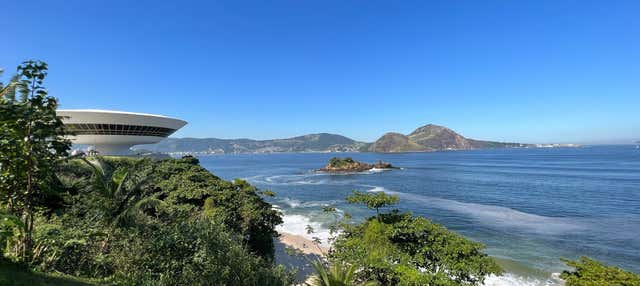
The contemporary art museum designed by Oscar Niemeyer, a concrete disc suspended over the Boa Viagem Lookout, with Sugarloaf Mountain and Guanabara Bay framed by the red access ramp. Open Tuesday to Sunday.
At the top of Morro da Viração, at 270 m, it has the best-known hang gliding ramps in Brazil and a 360° lookout: on one side Christ the Redeemer, Sugarloaf Mountain and the bridge, on the other the ocean beaches of Itacoatiara, Camboinhas and Piratininga.
A 700 m cove surrounded by preserved Atlantic Forest, with the strongest sea in Niterói: big waves that attract serious surfers and have been compared to those at Nazaré, in Portugal. The right-hand end, Prainha, is more sheltered for those who want to avoid the surf.
An ocean beach with calmer water than Itacoatiara, with a wide strip of sand between the Piratininga Lagoon and the open sea. It is a quiet residential neighborhood, popular with those who want a beach without the bustle of Rio.
A 16th-century fort built at the entrance to Guanabara Bay, in Jurujuba, still under Army administration. Guided tours leave every hour, with a soldier accompanying the group past the cannons and the view of the bay entrance.
Seven buildings by Oscar Niemeyer by the sea, from Praça do Povo to Charitas Station, including the Teatro Popular and the Roberto Silveira Memorial. An open-air museum that you explore on foot or by bike.
Between Itacoatiara and Camboinhas, a neighborhood beach with less activity and the Piratininga Lagoon right behind it. A good option for escaping the weekend crowds without leaving the ocean circuit.
The 13.3 km of the Presidente Costa e Silva Bridge link the two cities over Guanabara Bay. Driving across at sunset, with Rio receding in the rearview mirror, is one of the most beautiful outings in the region.
Brazil is in the Southern Hemisphere, so the seasons are reversed compared with Europe and North America: summer runs from December to March and winter from June to August. In Niterói summer is hot, with highs of 29 to 30 °C and lows of 22 to 23 °C, and winter is mild: in July, the coolest month, the average high is 25 °C and the average low is 18 °C. The reference climate is that of the Rio de Janeiro station, on the same Guanabara Bay and about 15 km from Niterói, since the city has none of its own.
The driest months are July, with 41 mm of rain over 7 days, August, with 44 mm over 7 days, and June, with 49 mm over 7 days. The wettest are January and December, with 137 mm over 13 days each, and February and March, with 130 mm each (over 11 and 12 days).
The most favorable window runs from May to September. That is the most comfortable period for walking the Niemeyer Way and climbing to the lookouts. On sunny weekends the ocean beaches fill up with visitors from Rio, so to enjoy them in peace, go on a weekday or set out early.
| Month | High | Low | Rain | Rainy days | Rating |
|---|---|---|---|---|---|
| January | 30 °C | 23 °C | 137 mm | 13 | Fair |
| February | 30 °C | 23 °C | 130 mm | 11 | Fair |
| March | 29 °C | 23 °C | 130 mm | 12 | Fair |
| April | 28 °C | 22 °C | 96 mm | 10 | Fair |
| May | 27 °C | 20 °C | 70 mm | 8 | Good |
| June | 26 °C | 19 °C | 49 mm | 7 | Good |
| July | 25 °C | 18 °C | 41 mm | 7 | Good |
| August | 26 °C | 18 °C | 44 mm | 7 | Good |
| September | 25 °C | 19 °C | 64 mm | 9 | Good |
| October | 26 °C | 20 °C | 89 mm | 11 | Good |
| November | 28 °C | 21 °C | 104 mm | 11 | Fair |
| December | 29 °C | 22 °C | 137 mm | 13 | Fair |
Monthly averages for 1991-2020 from INMET (Brazil's National Institute of Meteorology). The rating combines rainfall, temperature and humidity.
In summer (December to February), Niterói has highs of around 30 °C (86 °F) and lows of 23 °C (73 °F), and it is the wetter season, with about 135 mm of rain spread over about 12 days a month. The days are hot and call for beach time and shade.
In fall (March to May), Niterói has highs of around 28 °C (82 °F) and lows of 22 °C (72 °F), and it is the wetter season, with about 99 mm of rain spread over about 10 days a month. The days are hot and call for beach time and shade.
In winter (June to August), Niterói has highs of around 26 °C (79 °F) and lows of 18 °C (64 °F), and it is the driest time of year, with about 45 mm of rain a month. Temperatures are pleasant for sightseeing all day.
In spring (September to November), Niterói has highs of around 26 °C (79 °F) and lows of 20 °C (68 °F), and it is the wetter season, with about 86 mm of rain spread over about 10 days a month. Temperatures are pleasant for sightseeing all day.
Weather, crowds, prices and what is happening at the destination in each period. Tap a month to open its full page; the colored dot shows how good the time is for a visit.
Free choro concerts bring together instrumentalists from all over the country at the Reserva Cultural.
Panels with Brazilian and foreign authors, a book fair and children's programming.
Recurring annual events: exact dates change every year, so confirm them before you plan your trip.
The reference airport is Santos Dumont (SDU), in Rio de Janeiro, about 15 km away; from downtown Rio you can cross the bay by ferry in about 20 minutes. The gateway from abroad is Galeão International Airport (GIG), also in Rio, about 25 km away. Routes and airlines change often; the safest approach is to check them when planning your trip.
By road, Niterói is 18 km from Rio de Janeiro (less than half an hour), 154 km from Búzios (about 2.5 hours) and 75 km from Petrópolis (about 1.3 hours). From Rio you cross over the Rio-Niterói Bridge.
The tourist areas of Niterói are the city center, Icaraí, Boa Viagem (where the MAC is) and the ocean beaches of Itacoatiara, Camboinhas and Piratininga, all with plenty of activity. Camboinhas is a quiet residential neighborhood, and Piratininga has a neighborhood feel and fewer people. Many visitors make Niterói a day trip from Rio. If you prefer to stay overnight, you can choose according to your plans: near the center and Boa Viagem for the MAC and the Niemeyer Way, or on the ocean beaches for the open sea.
Rates change with the dates: confirm the price on Booking.com.
If you are leaving from downtown Rio, the ferry is the most practical and beautiful way: it leaves from Praça XV and crosses the bay in about 20 minutes. By car, the crossing is over the Rio-Niterói Bridge.
One to two days cover the essentials: the MAC and the Niemeyer Way in one day, and a second day on the ocean beaches of Itacoatiara, Camboinhas or Piratininga. Many people make Niterói a day trip from Rio.
Yes, even if you are not a fan of contemporary art. The experience is as much the Oscar Niemeyer building, suspended over the sea with a view of Sugarloaf Mountain, as the exhibitions themselves. It is open Tuesday to Sunday, from 10 a.m. to 6 p.m.
Itacoatiara has the most beautiful and strongest sea, ideal for surfers or anyone who enjoys big waves. Camboinhas is calmer and wider, good for spending the day with the family. Piratininga lies between the two, with a neighborhood feel and less activity.
The tourist areas (the city center, Icaraí, Boa Viagem, where the MAC is, and the ocean beaches) have plenty of activity and a constant flow of people. As in any big city, avoid displaying valuables and prefer ride-hailing apps at night.
May to September, the driest months, with highs of 25 to 27 °C. July is the driest (41 mm over 7 days). Summer, from December to March, is hotter and rainier (137 mm over 13 days in both December and January).
The weather and population data in this guide come from official agencies and open databases. Entry requirements and health recommendations change: always check the official source linked.