
8.7· 47 reviews
Ticket to Skyglass Canela
If you're in Canela and are craving thrilling adventure coupled with breathtaking vistas, don't miss out on this unforgettable Skyglass experience!
from US$ 29
Canela calls for 2 to 3 days for the Stone Cathedral, Parque do Caracol and the Vale da Ferradura, and many travelers add those days to a stay in Gramado, 8 km away. There is no marked dry season: it rains all year, between 138.6 and 220.2 mm a month. The least rainy months are April (138.6 mm over 9 days), June and August, and the window with the best weather runs from August to December. Summer reaches a high of 27.8 °C in January and winter is truly cold: the low drops to 7.8 °C in July.
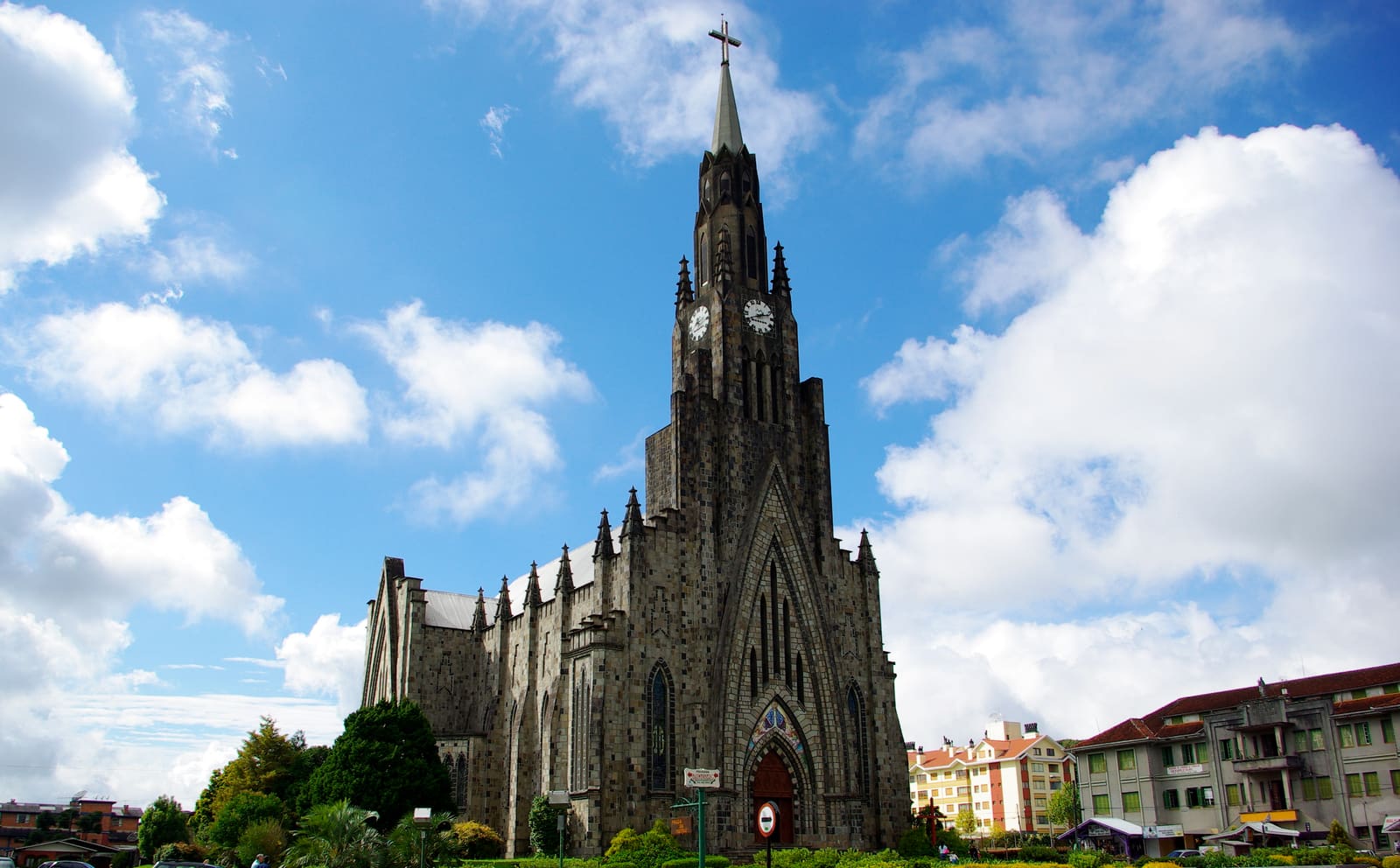
The first urban settlement in Canela was born in 1903, when Colonel João Ferreira Corrêa da Silva settled in the region and opened the road to Taquara, the district the locality belonged to. It became a separate municipality only in 1944. The town grew with families of ranchers from the Campos de Cima da Serra highlands and with German and Italian immigrants, a mix that can still be seen in the architecture, the food and the local festivals. The symbol of that growth is the Stone Cathedral: 34 years of construction, from 1953 to 1987, in English Neo-Gothic style, with a 65-meter tower, stained-glass windows that tell the Litany of Our Lady and a carillon of 12 bells cast in Italy. It stands in the center and is practically the starting point for any tour of the town.
At more than 830 meters above sea level, Canela has truly cold winters: average lows from June to August range from 7.8 to 9.1 °C, with frost common and records that have gone below -3 °C. Rain is generous and well spread throughout the year, more than 2,000 mm annually, which sustains the araucaria forest and feeds the waterfalls that make the town famous. The largest is the Cascata do Caracol, which drops 131 meters inside the Caracol State Park. It is a damp, misty mountain climate, good for anyone who enjoys walking around in a coat and breathing in the smell of wet forest.
If Gramado bet on the European showcase and theme parks, Canela kept the outdoor side of the region: state parks, trails, viewpoints over canyons and waterfalls. Among the newest attractions are the Skyglass, a glass platform suspended over the Vale da Ferradura (Horseshoe Valley), and Alpen Park, with walkways among the trees and zip lines in the middle of the forest. At night the town also gives in to the Christmas mood: the Sonho de Natal (Christmas Dream), from October to January, takes over the streets with the same force as its neighbor's Natal Luz (Christmas Light). Since it is 8 km from the center of Gramado, you can sleep in one and visit both without rushing.
Updated on October 19, 2026
A church in English Neo-Gothic style built between 1953 and 1987, with a 65-meter tower and a carillon of 12 bells cast in Italy. It is the landmark of downtown Canela and the starting point of almost every tour of the town.
A 131-meter waterfall inside the Caracol State Park. A panoramic elevator takes you to a glass platform 27 meters high, with a view of the whole waterfall.
Trails and viewpoints over the Vale da Ferradura, where the Caí River makes a tight, horseshoe-shaped bend surrounded by rock walls up to 420 meters high.
The world's largest cable-stayed glass-and-steel platform, extending 35 meters out over the Vale da Ferradura. Next to it is the Abusado, a ride that glides along rails with a view of the canyon.
Walkways suspended among the trees and two zip lines in the middle of the forest, a few minutes from the Stone Cathedral.
A theme park with handcrafted miniature replicas of steam machines (sawmills, potteries, locomotives), built by the Urbani family since 1991.
A collection of 44 working vintage cars, from the Ford Model T to the 1980s, plus hundreds of miniatures and automotive memorabilia, in the center of town.
Brazil is in the Southern Hemisphere, so the seasons are the reverse of those in Europe and North America: summer in Canela falls between December and March and winter between June and August. Summer is warm, with highs of 27.4 to 27.8 °C between December and February and lows of 16 to 17.2 °C. Winter is truly cold: in July, the coolest month, the average high is 18.6 °C and the low is 7.8 °C.
There is no marked dry season: it rains all year and fairly evenly. The least rainy months are April (138.6 mm over 9 days), June (141.9 mm over 10 days) and August (143.2 mm over 10 days). The wettest are October (220.2 mm over 12 days), January (214.1 mm over 13 days) and February (203.5 mm over 11 days).
Taking temperature and rainfall together, the window with the best weather runs from August to December. If you are after mountain cold and frost, the best time is winter, from June to August; from October to January the Sonho de Natal takes place. Outside those periods the weather is already cool and prices drop. Always pack a coat: even in summer the nights get chilly. These are multi-year averages, not a guarantee for your dates.
| Month | High | Low | Rain | Rainy days | Rating |
|---|---|---|---|---|---|
| January | 28 °C | 17 °C | 214 mm | 13 | Fair |
| February | 28 °C | 17 °C | 204 mm | 11 | Fair |
| March | 27 °C | 16 °C | 165 mm | 10 | Good |
| April | 24 °C | 14 °C | 139 mm | 9 | Good |
| May | 21 °C | 10 °C | 144 mm | 10 | Fair |
| June | 19 °C | 9 °C | 142 mm | 10 | Fair |
| July | 19 °C | 8 °C | 174 mm | 11 | Fair |
| August | 21 °C | 9 °C | 143 mm | 10 | Fair |
| September | 22 °C | 10 °C | 186 mm | 10 | Fair |
| October | 24 °C | 13 °C | 220 mm | 12 | Fair |
| November | 26 °C | 14 °C | 162 mm | 11 | Good |
| December | 27 °C | 16 °C | 187 mm | 11 | Fair |
Monthly averages for 1991-2020 from INMET (Brazil's National Institute of Meteorology). The rating combines rainfall, temperature and humidity.
In summer (December to February), Canela has highs of around 28 °C (82 °F) and lows of 17 °C (63 °F), and it is the wetter season, with about 202 mm of rain spread over about 12 days a month. The days are hot and call for beach time and shade.
In fall (March to May), Canela has highs of around 24 °C (75 °F) and lows of 13 °C (55 °F), and it is the wetter season, with about 149 mm of rain spread over about 10 days a month. The weather is milder, good for walking and exploring without the summer heat.
In winter (June to August), Canela has highs of around 20 °C (68 °F) and lows of 9 °C (48 °F), and it is the wetter season, with about 153 mm of rain spread over about 10 days a month. The weather is milder, good for walking and exploring without the summer heat.
In spring (September to November), Canela has highs of around 24 °C (75 °F) and lows of 12 °C (54 °F), and it is the wetter season, with about 189 mm of rain spread over about 11 days a month. The weather is milder, good for walking and exploring without the summer heat.
Weather, crowds, prices and what is happening at the destination in each period. Tap a month to open its full page; the colored dot shows how good the time is for a visit.
Celebrates the German, Italian and Portuguese heritage of the highlands, with colonial food, music and dance.
The city's traditional book fair, with book signings and cultural programming in the center.
Canela's Christmas fills the city for almost three months, with hundreds of attractions and much of the programming free.
Recurring annual events: exact dates change every year, so confirm them before you plan your trip.
The nearest airport is Salgado Filho International Airport (POA), in Porto Alegre, about 123 km from Canela.
From Porto Alegre, the overland route is 123 km along the BR-116 and the RS-235, about 2 h 15 min climbing the mountains. From Gramado it is 8 km, about 15 minutes, and from Caxias do Sul, 76 km, about 1 h 35 min.
Routes and airlines change often; the safest approach is to check them when planning your trip.
The center of Canela is small and can be covered on foot, with the Stone Cathedral as the reference point. The main parks (Caracol, Ferradura, Skyglass and Alpen Park) are 3 to 14 km from the center, with little public transportation, so choose where to stay with getting around in mind. Since the center of Gramado is 8 km away, about 15 minutes by car, you can sleep in either town and visit both on the same trip. In high season (winter and Christmas) prices rise in both.
Rates change with the dates: confirm the price on Booking.com.
It depends on what you are after. Winter (June to August) brings mountain cold, frost and a grayer landscape; from October to January the Sonho de Natal takes place, with decorations and shows around town. In July, the Festa Colonial (Colonial Festival) celebrates the German and Italian heritage with traditional food and parades. It rains all year; the least rainy month is April (138.6 mm) and the window with the best weather runs from August to December.
Two to three days are enough to see the Stone Cathedral, Parque do Caracol and the Vale da Ferradura at a relaxed pace. Many people add those days to a stay in Gramado, since the towns are 8 km apart.
Yes, the trip between the centers takes about 15 minutes. But since each town has parks and attractions that take half a day or more, the ideal is to set aside at least one full day for each.
The drop is 131 meters and it is inside the Caracol State Park. A panoramic elevator takes you to a glass platform 27 meters high, with a view of the whole waterfall.
It helps quite a bit. The center is small and can be covered on foot, but the main parks (Caracol, Ferradura, Skyglass and Alpen Park) are 3 to 14 km from the center, with little public transportation.
Generally yes: lodging and restaurants tend to cost a little less than in its neighbor, although the difference varies by season and category. In high season (winter and Christmas) prices rise in both towns.
The weather and population data in this guide come from official agencies and open databases. Entry requirements and health recommendations change: always check the official source linked.


